

Have you ever clicked on something promising, an eye-catching headline, an offer too good to be true, and found yourself on a site that confused you or made you lose interest? It may have appeared good, yet something was lacking. It provided no direction, and it didn’t feel like it was meant for you. So, like everyone else, you left. That moment may look small, but for marketers, that is everything.AI Landing
Landing pages play a crucial role in guiding user actions. Unlike a home page that encourages users to explore and discover their interests within the site, a landing page has a single, clear purpose. It is designed to guide the visitor to a specific action, such as signing up, making a purchase, or requesting a demo. Everything within it is directed toward achieving that one result.
What is interesting is how much value these pages can hold. Companies with 31-40 landing pages receive up to 7 times more leads than those with only a few pages. And that’s not just about the quantity. It’s about creating tailored experiences that meet people where they are.
Email marketing proves the power of marketing effects. For every dollar, there is an average return of 36 dollars. That return may only be possible due to the landing page doing its job. If the message on the page does not connect, the opportunity becomes lost.
One of the most striking insights is that the average landing page converts at 2.35 percent; the best landing pages convert at 5.31 percent or above. That is twice the score just by making the page right. That is a massive lift to any campaign.
So yes, landing pages matter because they transform curiosity into action, where decisions get made and where your marketing really has its moment.
This blog explores how marketers traditionally created and tested these pages, how AI is changing our approach, and what innovative tools make this possible and groundbreaking. We would also look into whether machines can come up with better CTAs than we can, since that could determine how landing pages will be crafted in the future.
How Marketers Traditionally Optimize Pages
Given the effectiveness of landing pages, it’s natural to wonder how marketers have been enhancing them over the years. What makes one landing page convert better than the next? And how do we figure that out?
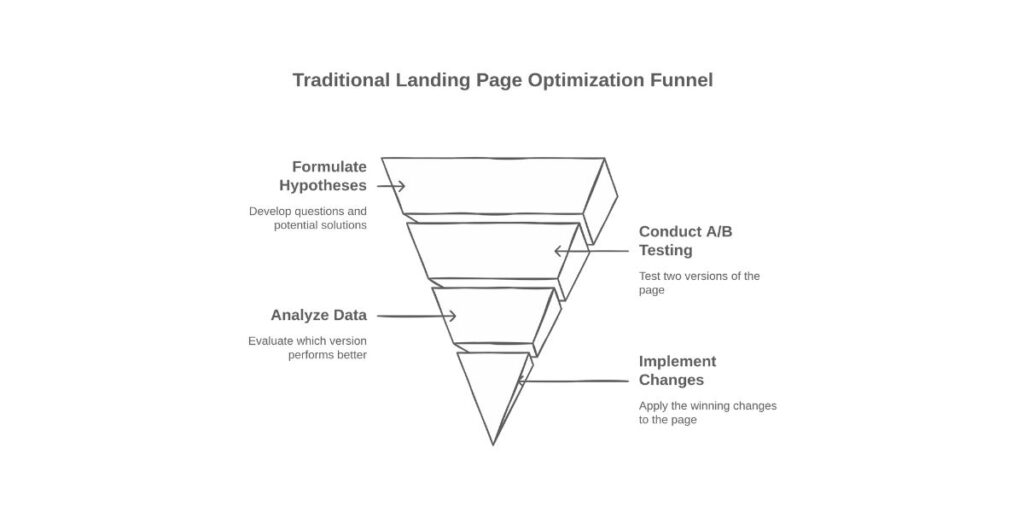
Conventionally, an ordinary idea initiates the process. Marketers read through a webpage and pose questions. Would it be better to write a more understandable headline? What would have happened if the button had been more prominent? These questions become the basis of hypotheses. Then comes the test. There are two versions of the page: one with no changes and one with one change. Visitors are then divided into two groups, and over time, data indicates which one is better.
This approach is referred to as A/B testing, which has enabled marketers to understand a great deal of what motivates action. It’s slow, but insightful. It reveals which headlines are attention-grabbing, what forms are filled out, and what buttons are actually clicked.
And yet, even though this process is beneficial, it is tested regularly by only 52 percent of businesses that use landing pages. It implies that approximately half of them might be missing significant opportunities to improve.
The majority of tests nowadays center around acquisition. Marketers test the title, the length of the form, the setup, and most importantly, the call to action. They all play a role in how someone completes the page and whether or not they convert.
The reason this approach is very humanistic is primarily because, for the marketers, it is purely on instinct. The marketers do not consider numbers alone; they observe behavior and utilize their experience as well as trust their intuition. For example, it is said that 94 percent of users consider easy navigation to be the most crucial characteristic of a website. Most of the time, determining whether something feels confusing or smooth comes down to the marketer’s own assessment.
The disadvantages of this sort of test are obvious: you can only test one idea at a time; it takes days, sometimes weeks, to generate results; and by the time a winner is found, the industry may have already shifted.
Read: How To Tell If a Burberry Bag is Real?
How AI is Changing Landing Page Optimization
In the previous part of this section, we looked at how marketers have relied on testing and intuition to improve landing pages. A lot has been learned from that, but it is a lengthy and restrictive process. In comes something completely new, which is game-changing.
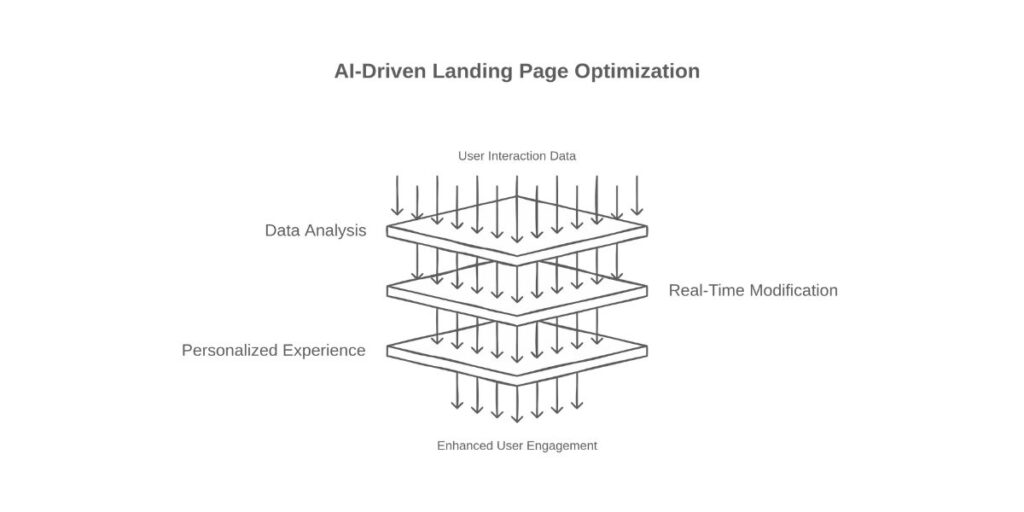
Artificial intelligence is not just another method; it has changed the entire perspective of the way we approach optimization. No longer will a change be tested one at a time and wait days for results. AI analyzes vast quantities of data and modifies the page almost instantaneously. This marks a significant leap from earlier CRO automation techniques, which relied on rule-based systems and manual workflows. While users interact, it learns from what works and does so across hundreds of variations at once.
This means marketers can no longer rely solely on past data for decision-making. AI allows for real-time modifications. For example, one visitor from one location might see a version of the page that looks completely different from what someone else might see, as the system adapts based on behavior, device, or traffic source.
And it is not solely speed. AI also takes away the burden of repetitive analysis. It monitors patterns, tests concepts, and highlights what matters, while giving marketers more room to think about strategy. On average, AI can spare teams anywhere between 1 and 4 hours per week on data tasks alone. This time can be utilized to construct stronger campaigns or discover new opportunities.
This transformation is coming at a fast pace. 83% of companies have already categorized AI into their top-tier objectives. It is not just the leaders advocating for such initiatives. 69% of marketers have declared that they feel energized by AI in a manner that allows them to do more and think bigger.
The most powerful aspect is that AI does not replace the marketer. It is working alongside them. It brings the scale and speed, while the marketer brings the creativity and voice. Collectively, they are capable of creating smarter, faster, and more relevant landing pages for each visitor.
The Tools Behind AI-Powered Pages
We’ve explored how artificial intelligence enables marketers to react faster, make smarter testing decisions, and bring landing pages to life, but what is behind this? What exactly is powering this transformation from static pages into seemingly adaptive pages?
At the heart of this is AI-powered conversion rate optimization and personalization platforms. The tools quietly run in the background, collecting real-time data on every visitor, what they click on, how far they scroll, what device they are using, and even where they came from. All of this information helps the system decide what content to show and how to shape the experience for that individual.
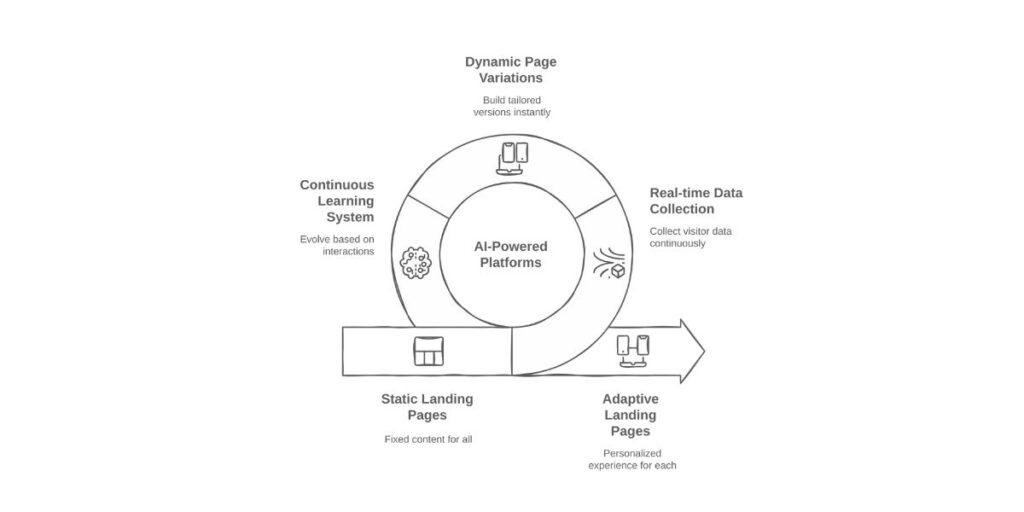
This is the point where it becomes a big difference from the old method of doing things. Rather than having a single fixed landing page accessible to all, these platforms can build thousands of variations dynamically. Every version is tailored to the visitor’s requirements, preferences, or actions at that precise moment. The headline might change. The layout might shift. The call to action may be more relevant. And none of it involves a lengthy process or waiting weeks to test a result.
Now, the difference is evident. Previously, we discussed how A/B testing is a process of making a single change and gradually testing its impact. Under AI, each visitor receives an adapted version of the page with the highest probability of working, and the system continuously learns as the visitor interacts with it. The page is no longer static. It is constantly evolving.
The guesswork has been largely eliminated, which is what gives these tools much of their power. Rather than depending on hunches or assumptions, marketers are given recommendations based on actual user behavior. Optimization has, thus, changed- from a slow-moving experiment to something alive and driven by data.
It has gained so much momentum that adoption is expected to grow rapidly. 42% of companies are already using AI tools like chatbots, recommendation engines, and predictive analytics to improve their customer experience. Many of these platforms can also pull in data from multiple marketing channels to help teams see how people move across campaigns and touchpoints. That kind of integration allows marketers to make better decisions and create more seamless experiences.
Proof That AI Boosts Conversions
Landing pages are being customized in real time using AI tools that process live data to deliver personalized experiences and direct all visitors to act. But here comes the big question. Does it actually work?
The great thing about AI is that we’ve discussed its capabilities, but the bottom line is always results. Do these platforms actually speed things up and convert more customers? The answer, backed by real numbers, is a clear yes.
Automated A/B/n Testing at Scale
AI takes what we once did manually and scales it in ways that were never possible before. Instead of testing two headlines or two call to actions, it can test hundreds at once. It examines images, layout, copy, and more, learning which combinations work best. The winning version is not decided after weeks of testing. It is identified within minutes and applied in real time.
Predictive Personalization in Action:
This ability goes beyond reacting to what a visitor does. AI can predict what someone is likely to need before they even ask. It uses patterns in data to anticipate behavior and serve content that matches intent. Instead of waiting for a click to respond, the page adjusts itself in advance, making the experience feel seamless and relevant.
And the impact is not subtle. Landing pages that use personalized calls to action convert 202 percent better than those with generic ones. That is more than double the performance, simply by using AI to deliver the right message to the right person. Marketers using AI-generated content also see a 36 percent higher conversion rate compared to those relying on manual methods.
We can also see this in real-world examples. Amazon’s recommendation engine is one of the most well-known uses of predictive personalization. It analyzes your browsing and purchase history to suggest products, and this strategy drives an estimated 35 percent of the company’s revenue. Volkswagen applies a similar approach. Their AI model identifies users who are most likely to buy, then delivers landing pages and ads tailored specifically to them. The result is more efficient campaigns and better leads.
All of these points lead to one conclusion. AI is not just improving landing pages. It is helping marketers deliver experiences that are more targeted, more relevant, and more likely to convert.
Conclusion
This journey began with a simple question: Can machines write better CTAs? After seeing how AI personalizes content, runs rapid tests, and learns from every interaction, the answer leans toward yes. But its real strength comes when paired with human insight. AI brings the speed and precision, while marketers bring the message, intent, and creative direction.
The takeaway is clear. Use AI as a collaborator, not a replacement. Let it handle the data and testing, while marketers focus on strategy and storytelling. Together, they can turn landing pages into smarter, more relevant experiences that actually drive action.
Author’s Bio:
Vidhatanand is the Founder and CEO of Fragmatic, a web personalization platform for B2B businesses. He specializes in advancing AI-driven personalization and is passionate about creating technologies that help businesses deliver meaningful digital experiences.